The paid-media account standard, v1.0.
A checklist everyone agrees with is worthless, because a criterion without a number cannot be failed. So this one has thresholds, weights, a gate, and a version number. Score any account against it in an afternoon.
There is no shortage of "what a healthy account looks like" checklists, and they share one fatal property: you can agree with every item and change nothing. "Budgets are set at a level that lets campaigns exit the learning phase" is unarguable and unfailable. Nobody has ever read it and concluded their account falls short, because there is no number to fall short of. A standard that cannot produce a failure is a values statement.
So this is the same body of discipline rebuilt as something you can actually score. Twenty-two criteria, each with an explicit pass condition. Weights, because the layers are not equally consequential. A gate, because some failures make the other scores meaningless rather than merely lower. And a version number, so a score from this year can be compared with a score from next year rather than quietly re-based.
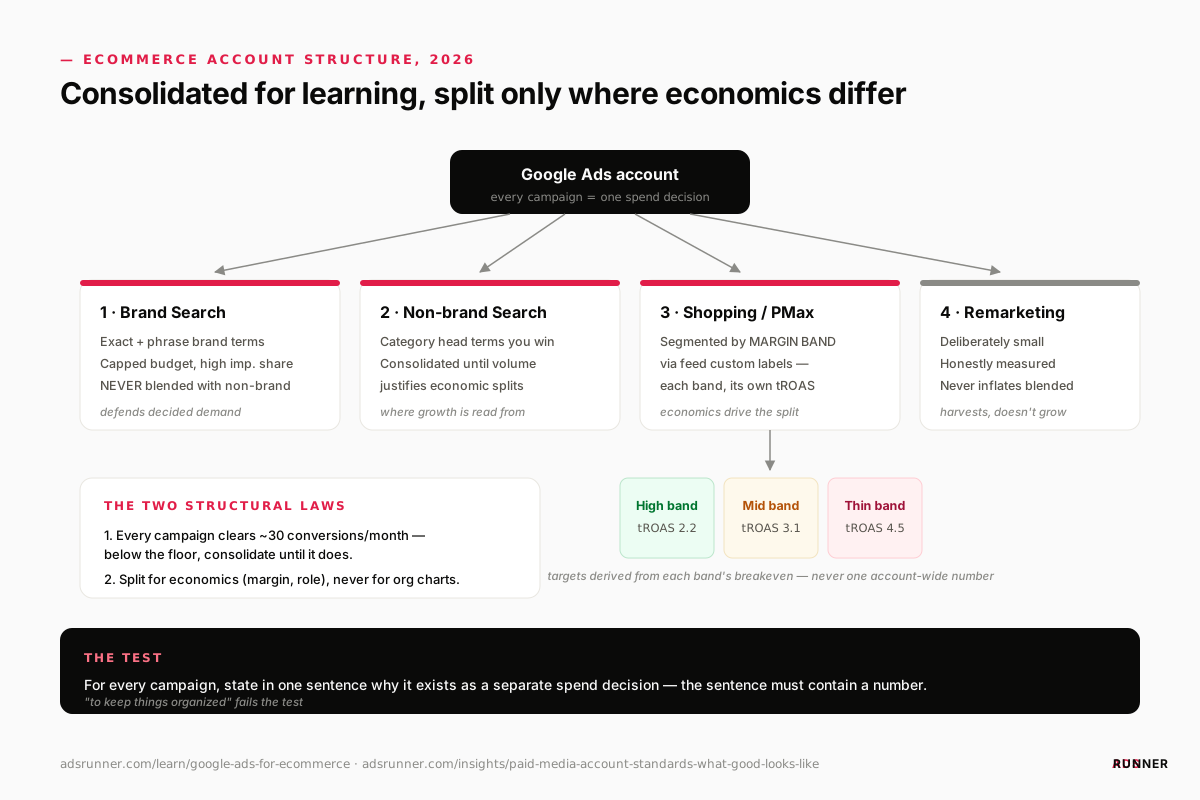
Embed this infographic on your site
<a href="https://www.adsrunner.com/insights/paid-media-account-standards-what-good-looks-like"><img src="https://www.adsrunner.com/infographics/google-ads-account-structure-2026.svg" alt="Reference Google Ads account structure for ecommerce in 2026: brand search isolated, non-brand search consolidated, Shopping or Performance Max segmented by margin band with per-band tROAS targets, and a deliberately small remarketing campaign, with the rule that every campaign must clear roughly 30 conversions per month." width="1200" style="max-width:100%;height:auto;" /></a>
<p>Infographic by <a href="https://www.adsrunner.com/insights/paid-media-account-standards-what-good-looks-like">ADSRUNNER</a></p>
Free to use with the attribution link intact. A PNG version is available at the same path with a .png extension.
A. Architecture (weight 20)
- A1 — Brand is isolated in its own campaign, AND brand leakage into non-brand campaigns is under 5% of non-brand spend, measured by search-term segmentation. Never having measured the leak is a fail, not an unknown.
- A2 — Every campaign carrying more than 2% of account spend clears roughly 30 conversions a month. Below that, the campaign is a reporting line rather than an optimizable unit and should be consolidated.
- A3 — Every campaign has a named owner and a one-sentence rationale containing a number. No exceptions for legacy campaigns; a campaign nobody will defend in a sentence is a campaign to pause.
- A4 — Geographic and language targeting matches where the business can actually fulfill, with zero spend in regions it cannot serve. Verify against the location report, not against the settings screen.
- A5 — Where a brand campaign exists, Performance Max carries brand exclusions and the account carries brand negatives. Unexcluded PMax silently reabsorbs the traffic A1 separated.
B. Conversion definitions (weight 30, gating)
The heaviest weight and one of two gating sections, because Smart Bidding optimizes toward whatever you told it counts. A wrong definition here does not degrade performance at the margin; it points the entire account at the wrong objective while every dashboard reports success.
- B1 — Every active conversion action has a written one-sentence definition of what it counts. Count of undocumented active actions must be zero.
- B2 — No more than three primary conversion actions per campaign objective. Micro-conversions are set to secondary or observation, never bid toward alongside purchases.
- B3 — Platform-reported conversion count sits within 5% of the commerce or CRM count for the same window, or the gap has a written explanation. This is the test that catches confirmation-page reloads and duplicate fires, which no settings review will find.
- B4 — Conversion values carry margin rather than flat revenue wherever the catalog spans more than roughly 10 points of margin. A single flat value across mixed margins instructs the algorithm to prefer your worst products.
- B5 — The definitions carry a last-reviewed date under 90 days old. Configured-once-and-forgotten is the normal state and it is a fail.
B3 is the criterion most accounts fail without knowing it, because it is the only one here that cannot be checked inside the ad platform. It requires holding the platform’s conversion count next to your store’s order count for the same dates, a comparison that takes ten minutes and that most accounts have never once run.
C. Measurement (weight 30, gating)
- C1 — One declared revenue truth source, written down where the targets live, and used consistently. Multiple sources in circulation with no declared arbiter is a fail regardless of how good each source is.
- C2 — Server-side conversion tracking is live alongside the browser pixel, with shared event IDs so the two do not double-count.
- C3 — Platform-claimed revenue is reconciled against the truth source monthly, and the divergence is kept as a time series rather than checked once. The trend is the signal; a single reading tells you nothing about whether tracking is degrading.
- C4 — Blended MER is reported next to per-channel ROAS, over the same window, with the convention stated. A target expressed without its convention is the error described in MER vs ROAS.
- C5 — Brand, non-brand and incremental views exist as separate lines, not merely a blended headline. See brand vs non-brand for why the blend cannot be mentally corrected for.
- C6 — At least one incrementality test has been run in the last twelve months on a channel carrying over 20% of spend, sized so its detectable effect was smaller than the effect it looked for.
D. Hygiene (weight 10)
- D1 — Search term reports reviewed weekly, evidenced by negative lists carrying a last-modified date under 30 days.
- D2 — No campaign has been in learning for more than 14 days. Persistent learning is a structure or budget problem, not a waiting problem.
- D3 — Audience overlap checked quarterly so campaigns are not bidding against each other for the same person.
- D4 — Placement exclusions applied on display and video inventory, reviewed at least quarterly.
E. Governance (weight 10)
- E1 — Every material change is logged with date, author, rationale and expected effect. Without this, no future diagnosis of a performance drop is possible: you will be guessing at your own history.
- E2 — One document holds the targets, the revenue source, and the conventions they are stated in. Not a deck, not a thread, not somebody’s memory.
- E3 — Someone can name the binding constraint on growth this quarter in one sentence. An account optimized with no view on what is actually capping it is being polished rather than steered.
Scoring, and why there is a gate
Score each section as the share of its criteria passed, multiply by the section weight, and sum. Then apply the gate:
score = 0.20*A + 0.30*B + 0.30*C + 0.10*D + 0.10*E
        (each section as % of criteria passed)

GATE
  any fail in section B or C
  -> total capped at 60

BANDS
  90-100   healthy; tactical work is the best
           available use of time
  70-89    drifting; fix the named gaps before
           any new experiment
  50-69    structurally compromised; tactical
           work will not compound
  under 50 rebuild the foundation first
The gate is the part that makes this a standard rather than a scorecard. A pure weighted sum lets an account bank points for immaculate hygiene and governance while optimizing toward a conversion definition nobody has read, and that account is not eighty percent healthy, it is comprehensively broken with tidy paperwork. Sections B and C are upstream of every other number, so a failure there invalidates the rest of the score rather than reducing it. Any account scoring above sixty has, by construction, a sound conversion and measurement layer.
One honest note on using it: score the account you have, not the account you intend to have by Friday. Aspirational scoring is the standard failure mode of self-assessment, and it is the reason we run this against client accounts before the first strategic conversation rather than after. The first ninety days is largely the work of moving a score, and most audits miss precisely the B and C criteria because those cannot be checked from inside the interface.
What this standard deliberately excludes
What a standard leaves out is as load-bearing as what it includes, so here is the reasoning rather than a silence:
- Match-type doctrine — Broad versus phrase versus exact is a tactic whose correct answer depends on conversion volume and signal quality. A standard that prescribes it would be wrong for half the accounts it audits.
- Ads per ad group, keywords per ad group, campaign counts — No threshold survives contact with the range of account sizes this is meant to score. A number here would be arbitrary precision, which is worse than no number.
- Whether to run Performance Max, Demand Gen, or any campaign type — Strategy, not structure. A5 governs how PMax must behave if present; it does not adjudicate whether to use it.
- Quality Score and impression share — Both are outputs to diagnose with, not conditions to hold an account to. Managing directly to a diagnostic metric is how teams end up optimizing the thermometer.
- Anything requiring an industry benchmark — Every criterion above is verifiable against the account’s own data, deliberately. A standard that depends on comparison data you cannot inspect is not auditable by the person holding it, and the benchmark figures circulating in this industry are mostly unverifiable.
- Creative quality — Genuinely important, genuinely not reducible to a pass condition. Attempting one would produce the exact unfailable bullet this rewrite exists to eliminate.
Where the standard is weakest
- The thresholds are calibrated to mid-market and above — An account spending three thousand a month will fail A2 structurally, because thirty conversions per campaign is not available to it. Below roughly ten thousand a month, read A2 as "consolidate until it is true" rather than as a failure.
- Weights encode our judgment, not a measured fact — We put sixty points on conversions and measurement because that is where we find the damage; a lead-gen business with a long sales cycle might reasonably weight governance higher. Change them if you can defend the change, and record that you did.
- A high score is not performance — This measures whether the account is in a state where good decisions are possible. A structurally immaculate account can still be losing money on a bad offer, and no criterion here would catch it.
- C6 is the criterion most likely to be unaffordable — Incrementality testing has a real cost in revenue and attention, and at smaller spend levels a properly sized test may not be purchasable at all. Fail it honestly rather than running an underpowered test to tick it.
- Self-scoring is unreliable in a predictable direction — Everyone marks their own governance generously. If the score matters, have someone who did not build the account run it.
Versioning policy
This is v1.0, published 2026-08-06. Criteria may be added and thresholds may be tightened as the platforms change, but a criterion is never silently removed and a threshold is never quietly loosened. Either move bumps the version, so an account scored against v1.0 remains comparable to its own past score rather than being re-based by an edit. When a version changes, what changed and why is stated here. That is the whole reason it carries a number: a standard that revises itself invisibly cannot be used to measure drift, which is the only thing it was built for.
None of the twenty-two criteria is exotic, and that remains the point. Accounts fail not for want of clever tactics but because unglamorous disciplines drifted while everyone was busy being sophisticated. The difference between this and the checklist it replaces is only that this one can tell you that you failed, on a specific numbered line, on a date. That is the entire function of a standard, and it is why the version number matters more than the prose.
How do you audit a Google Ads account properly?
Score it against explicit thresholds rather than reviewing it against opinions, and start with the two layers that cannot be checked from inside the interface: what each conversion action actually counts, and whether platform-reported conversions reconcile with the store or CRM for the same window. Most audits examine structure, match types and bidding because those are visible on screen, and miss the conversion and measurement failures that make every visible number untrustworthy in the first place.
What should a healthy account structure look like?
Brand isolated from non-brand with measured leakage under five percent, every meaningful campaign clearing roughly thirty conversions a month so it is an optimizable unit rather than a reporting line, targeting that matches what the business can fulfill, and Performance Max carrying brand exclusions where a brand campaign exists. Note that structure carries only twenty of the hundred points here. It is the most visible layer and not the most consequential one.
Why do conversion definitions matter more than structure?
Because automated bidding optimizes toward whatever you declared a conversion, so a wrong definition aims the entire account at the wrong objective while every report shows success. Structural problems make an account inefficient; definitional problems make it efficient at the wrong thing, which is worse and much harder to see. That is why the conversion and measurement sections both gate the total score rather than simply contributing to it.
What is a good score against this standard?
Ninety or above means the account is in a state where tactical work compounds, and tactical work is then the best use of your time. Seventy to eighty-nine means drift that should be closed before any new experiment. Below seventy means tactical improvements will not stick, because they are being built on a foundation that moves. Any failure in the conversion or measurement sections caps the total at sixty regardless of everything else.
Can this standard be used on paid social as well as search?
Most of it transfers directly: the conversion, measurement, hygiene and governance sections are platform-agnostic, and they carry seventy of the hundred points. The architecture section is written with search in mind, so on paid social read A1 and A5 as being about audience and campaign overlap rather than brand keywords, and keep A2 and A3 as written since the conversion-volume and accountability logic is identical.
Written by Sam Nouri, founder, adsrunner. If this resonated and you want to apply it to your own account, you can book a strategy call or run a free audit.
How we research, source figures, and handle corrections: editorial policy.