How Performance Max actually works under the hood.
You cannot steer a system you do not understand. A working model of what PMax does between your inputs and your invoice.
Most Performance Max commentary treats the campaign type as either magic or malpractice. Both takes excuse you from understanding it. PMax is a black box in the sense that Google does not publish its internals, but its observable behavior is consistent enough that you can build a working model — and once you have one, the levers stop feeling random.
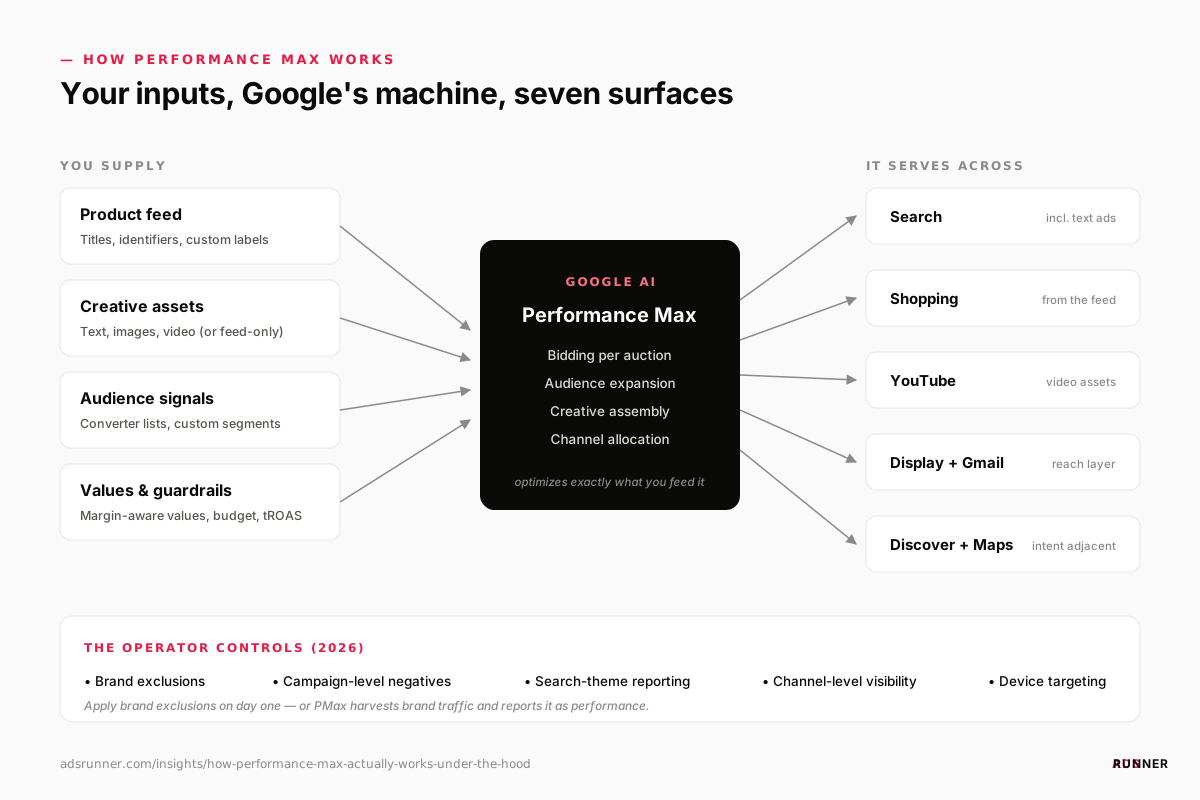
Embed this infographic on your site
<a href="https://www.adsrunner.com/insights/how-performance-max-actually-works-under-the-hood"><img src="https://www.adsrunner.com/infographics/how-performance-max-works.svg" alt="Diagram of how Performance Max works: your inputs (product feed, creative assets, audience signals, values and guardrails) flow into the Google AI core (bidding, audience expansion, creative assembly, channel allocation), which serves across Search, Shopping, YouTube, Display, Gmail, Discover, and Maps — with the 2026 operator controls listed below." width="1200" style="max-width:100%;height:auto;" /></a>
<p>Infographic by <a href="https://www.adsrunner.com/insights/how-performance-max-actually-works-under-the-hood">ADSRUNNER</a></p>
Free to use with the attribution link intact. A PNG version is available at the same path with a .png extension.
The three systems inside one campaign
It helps to think of PMax as three systems stacked on top of each other. The first is asset combination: Google assembles your headlines, descriptions, images, and video into ad formats appropriate to each surface — a Search text ad, a Shopping tile, a YouTube pre-roll, a Discover card. The second is surface arbitration: for every opportunity, the system estimates the probability of conversion across eligible surfaces and enters the auctions it expects to win profitably. The third is value bidding: the same Smart Bidding machinery that powers target ROAS and target CPA everywhere else, setting a bid per auction from predicted conversion value.
Everything confusing about PMax follows from the interaction of those three systems. The campaign is not choosing to ignore your beautiful video. The arbitration layer has concluded that Shopping tiles convert better for your feed, so the video rarely gets an auction to run in. The campaign is not refusing to prospect. The value layer has found that retargeting-adjacent users and brand searchers clear the ROAS target more reliably, so that is where the money goes.
Inputs are the real targeting
Because you cannot set placements or keywords directly, your inputs do the targeting. This is the mental shift that separates teams who get results from PMax from teams who complain about it.
- The feed is targeting. Product titles decide query matching on Shopping inventory. A title rewritten from the internal SKU name to the words customers actually search is a targeting change, and usually a bigger one than any bid adjustment.
- Creative is targeting. The people who respond to an ad define the audience Google learns. Creative aimed at everyone teaches the system nothing; creative aimed at someone teaches it who to find more of.
- Audience signals are a starting hypothesis. Google begins serving against them, watches who converts, then expands. Strong first-party lists shorten the expensive learning phase; they do not constrain the destination.
- The conversion goal is the strongest input of all. Feed the campaign purchase values and it chases revenue. Feed it lead events with no downstream qualification and it chases whatever converts cheapest, including junk.
The learning dynamics that punish impatience
Smart Bidding predictions are built on recent conversion history, which makes the system sensitive to abrupt change. Double the budget overnight and the model is suddenly bidding in auctions it has no data for; performance wobbles, the advertiser panics and reverts, and the account whipsaws. The same applies to target changes and wholesale asset swaps. Our operating rules are boring and effective: budget moves of no more than about 20% at a time, target moves of 10-15%, one structural change per learning cycle, and one to two weeks of stability before judging any of it.
A special case worth knowing: pausing PMax entirely for a few days — for example, during a stock crisis — resets more learning than the pause duration suggests. Where possible, cut budget hard instead of pausing. The model retains continuity, and recovery is days rather than weeks.
Where the model breaks down
The system optimizes to the letter of its goal, not the intent behind it. Three failure modes account for most of the PMax horror stories. Brand cannibalization: absent exclusions, brand searches are the cheapest conversions available, so the arbitration layer takes them first. Low-quality lead harvesting: without offline conversion feedback, Display-sourced form fills are indistinguishable from sales-ready inquiries. And existing-customer churn-and-burn: if your goal counts every purchase equally, the system happily spends acquisition budget on people who would have bought anyway. Each failure is the machine doing exactly what it was told. The fix in every case is telling it something truer — exclusions, imported offline outcomes, new-customer goals.
This is also why we invest so heavily in measurement infrastructure on our own accounts. The signal you feed the machine is the product you get out of it. The practical control set — and what to do about each of these three failure modes — is in how to actually control Performance Max. We cover structure specifically in our guide to structuring asset groups and the brand problem in the brand exclusions walkthrough.
What signals does Performance Max actually optimize on?
Conversion value and conversion probability, as predicted from your conversion feed, audience signals, asset engagement, and Google-side behavioral data. It does not optimize on your business goals directly — only on the proxy your conversion tracking describes. That is why the quality of the conversion signal matters more than any setting inside the campaign.
Why does PMax performance drop after I make changes?
Significant edits — new asset groups, big budget moves, target changes — partially reset the bidding model, and the campaign re-enters a learning period of days to weeks. The drop is usually temporary. The mistake is reacting to it with more changes, which compounds the reset. Change one variable, then hold for at least two weeks.
Does Performance Max cannibalize my Search campaigns?
It can. PMax loses to an exact-match Search keyword with a competitive ad rank, but wins most other overlaps, including phrase and broad match. Watch the search terms your Search campaigns lose after launching PMax, and protect the queries you care about with exact match and firm bids.
How do I see where Performance Max is showing my ads?
Google's reporting here is limited by design, but placement reports, asset group insights, and channel-level breakdowns released over the past two years show more than most operators realize. Third-party scripts can also estimate the Search vs Shopping vs Display split from engagement patterns. Imperfect visibility is not zero visibility.
Written by The ADSRUNNER team. If this resonated and you want to apply it to your own account, you can Take the growth check or run a free audit.
How we research, source figures, and handle corrections: editorial policy.
